Understand production performance
Estimate production, availability, expected failures and the operational behaviour of the complete system.
Reliability Digital Twin Software
AeROS® connects equipment reliability, maintenance strategy, system configuration, operating constraints and production flow—so engineers can understand consequences and compare alternatives before implementation.
AeROS® — Asset Reliability and Operations Simulation
Desktop application for Windows 10 or higher.
The AeROS Model
The Engineering Problem
Two systems can report similar availability yet deliver very different production outcomes. Bottlenecks, storage, redundancy, operating rate, maintenance resources and the location of each failure all influence the final consequence.
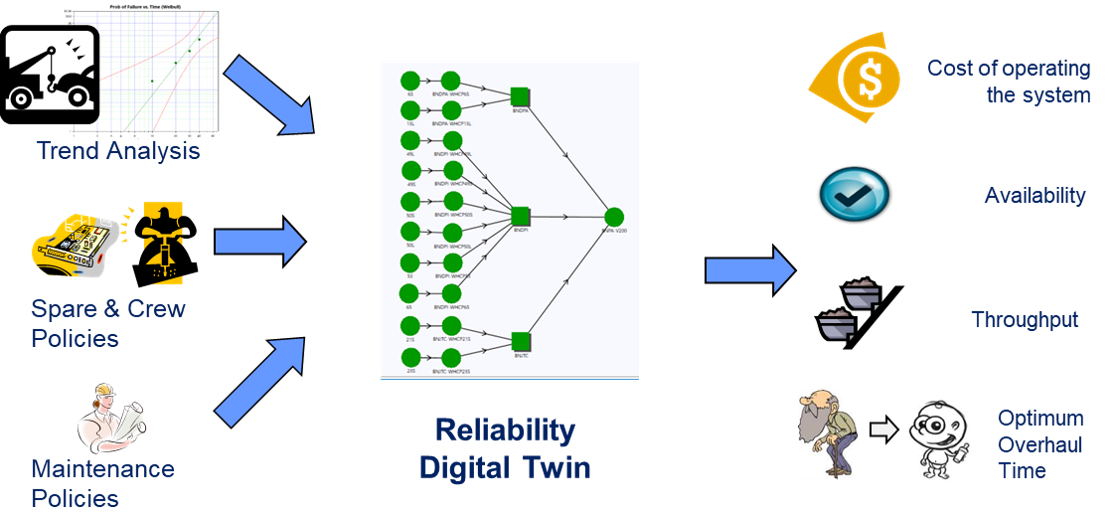
AeROS represents these relationships in a Reliability Digital Twin. Simulation then shows how equipment behaviour propagates through the production system, making the assumptions and trade-offs behind engineering decisions visible.
Engineering Decisions
AeROS is designed to help engineers investigate specific decisions, not merely calculate another availability value.
Estimate production, availability, expected failures and the operational behaviour of the complete system.
Use Critical Loss and Local Loss to distinguish equipment downtime from its actual contribution to system production loss.
Test configurations, operating strategies, reliability improvements and maintenance policies before implementation.
Evaluate how crew, spare availability and restock policies influence maintenance and production outcomes.
Modelling Capabilities
AeROS® goes beyond traditional Reliability Block Diagram (RBD) modeling by combining reliability analysis, production system simulation, and operational constraints within a single Reliability Digital Twin environment. It helps engineers quantify how equipment reliability, maintenance strategies, operational uncertainty, and system constraints affect production performance.
From Data to Model
AeROS includes built-in Life Data and Recurring Event analysis tools allowing reliability parameters to be estimated directly within the AeROS environment.
Users can analyze failure time data, suspension data, and recurring event data without exporting the dataset to external reliability software. The analysis results can then be immediately used in the simulation model.
This integrated capability provides several advantages:
historical failure data → reliability modeling → production and availability simulation.
Applied Engineering
Explore how reliability simulation can be applied to production systems, maintenance resources, storage, load sharing and other engineering questions.
Customer Evidence
AeROS continues to evolve through engineering work with organisations operating complex, production-critical assets.
AeROS is remarkably user-friendly with features that significantly enhance workflow efficiency. The cost of ownership is substantially lower than comparable RAM software solutions in the market.
Principal Engineer
Petronas Carigali Sdn Bhd
The advanced features in AeROS enable realistic production process modeling unmatched by other reliability simulation tools. This capability provides exceptional confidence in production system risk assessments.
Project Manager
Leading Refinery Plant in Indonesia
Tell us about the asset, operating context, available information and decision you need to support. We can help determine whether AeROS is the appropriate approach.