Introduction
In many production systems, parallel units share load under normal operation. When one unit fails, the remaining unit automatically takes on additional production. Hence, redundancy improves availability – a well-accepted engineering principle.
But what happens to asset life when one unit in a redundant system fails and the remaining units take on additional load?
In most traditional RAM studies, the answer is surprisingly simple:
Nothing changes!
And that is precisely the problem.
The Reality of Load Redistribution
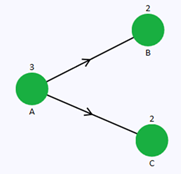
Asset A (max. production=3) is in series with B and C (max. production=2) in load-share configuration
Consider a simple but common configuration: an upstream unit feeds two parallel processing units. Under normal operation, both share the production load. Each unit is designed for a specific operating flowrate and corresponding design life.
Now imagine one of the parallel units fails. The surviving unit increases its production rate to compensate.
This is operationally correct.
But from a reliability standpoint, something important has just changed: The surviving unit is now operating above its design stress.
In physical systems, higher stress accelerates degradation. Yet many RAM models continue aging equipment based purely on calendar time – independent of production load.
This creates a silent distortion in lifecycle projections.
If your organisation is evaluating enterprise-level lifecycle cost strategy, consider whether your RAM methodology captures stress-dependent degradation.
Because in load-sharing systems, life is shared too.
The Executive Risk
When stress-dependent degradation is ignored:
- Asset life is overestimated.
- Cascading failure risk is underestimated.
- Maintenance budgets are misaligned.
- Lifecycle cost analysis (LCCA) becomes optimistic.
At portfolio scale – across dozens of plants – these deviations translate into significant financial exposure.
The issue is not availability.
The issue is life consumption.
From Time-Based Failure to Stress-Based Aging
Traditional RAM tools treat failure rates as fixed or state-based:
- Operating
- Standby
- Shutdown
But real industrial assets age because of stress, not because of time alone.
In advanced production-aware reliability modelling:
- Life is linked to operating stress.
- Degradation accumulates based on actual load.
- When load increases, life consumption accelerates.
- When load decreases, life consumption slows.
- When there is no production, there is no aging.
This reflects physical reality.
A Simple Example with Complex Consequences
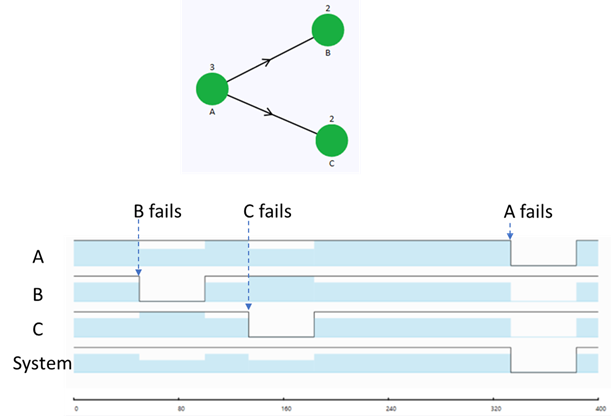
In a load-sharing system:
Consider unit B fails... see Figure 2.
- Unit C increases throughput.
- C now operates above its design flowrate.
- C’s remaining life reduces according to the life-stress relationship.
- By the time B recovers, C already accumulated more degradation than if B had not failed.
Meanwhile:
- The upstream unit (A) sees reduced load and survives longer.
These effects are not manually imposed.
They emerge naturally when production and degradation are mathematically coupled.
This is the difference between availability modelling and lifecycle realism.
Why This Matters for Enterprise LCCA
Enterprise lifecycle cost analysis requires more than uptime percentages.
It requires understanding:
- How operating decisions influence remaining life.
- How production targets impact asset degradation.
- How load-sharing policies affect long-term capital planning.
- How stress redistribution alters maintenance timing.
Without stress-dependent modelling, LCCA becomes a static projection disconnected from operational dynamics.
Beyond Traditional RAM
Modern asset portfolios – especially in power generation and energy transition – operate under variable loads:
- Demand fluctuations
- Dispatch optimisation
- Renewable integration
- Maintenance-driven load shifts
In such environments, production variability is not an exception – it is the norm.
Reliability modelling must evolve accordingly.
The Strategic Advantage
By integrating:
- Network flow redistribution
- Storage and buffering logic
- Stress-dependent life modelling
- Cumulative damage theory
AeROS enables decision-makers to evaluate not only –Will it run?– but also:
–How fast are we consuming asset life under this operating strategy?–
This shifts RAM from a reporting tool to a strategic planning instrument.
The Bottom Line
Redundancy improves availability.
But redundancy also redistributes stress.
And stress determines life.
If your reliability model does not reflect this relationship, your lifecycle projections may be incomplete.
In today’s capital-intensive industries, incomplete projections are expensive.
- End -